HDD Heads, Platters and Mechanical Failure
Mechanical HDD recovery does not aim to make a failing drive trustworthy again — it aims to restore a usable head-media system for just long enough to acquire the sectors that are still there. Replacing a head stack repairs the reading mechanism; it does not repair magnetic material that has already been scratched off the platter.
A head stack assembly, not just “the read/write head”
A modern HDD normally records across several surfaces, each served by its own read/write head mounted on an actuator arm. Together, the arms, sliders, heads, flex circuit and preamplifier connection form the head stack assembly (HSA). The drive's logical address space is distributed across these surfaces according to its internal translation, which is why a single physically defective head can affect only part of the media while still blocking normal initialization of the whole drive.
Weak head, dead head and head crash are different problems
A weak head may still read, just slowly, with more retries, or only under specific conditions. A dead head cannot read at all. A head crash is physical contact between a head and the spinning platter surface, and it is the more serious of the three: it can leave scratches, strip magnetic coating, generate debris, and cause repeated secondary contact as the damaged slider continues to fly unevenly. The clicking sound itself does not distinguish between these — what matters is whether continued operation is converting readable surface into physically destroyed surface, which is exactly why abnormal mechanical noise justifies stopping immediately rather than continuing to listen for a pattern.
One failed head can make an otherwise healthy drive look dead
During initialization, a drive may need to read servo information, service-area modules and calibration data through specific heads. If one of the heads required for that sequence cannot read correctly, the drive can spin, seek, fail, retry, reset, click and either spin down or remain busy indefinitely — never reaching a ready state even though other heads could still read large portions of user data if the drive could get that far.
Head maps let acquisition follow the physical drive, not just the LBA sequence
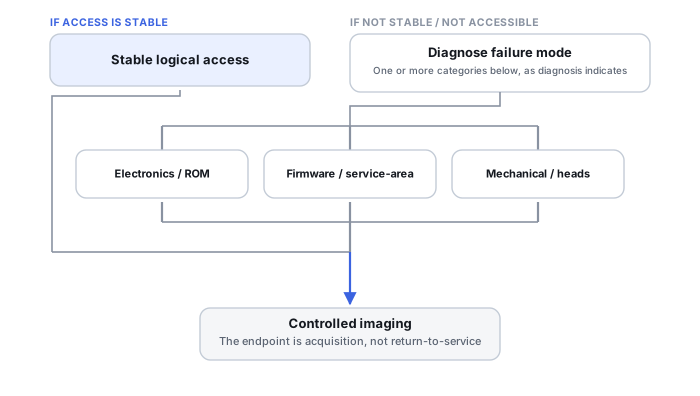
Professional imaging tools can maintain a head map: which logical address ranges correspond to which physical head or surface. That turns imaging from a blind sweep from sector 0 to the last LBA into a prioritized process — sectors behind good heads are acquired first, a weak head's sectors are deferred to a slower later pass, and a known-bad head's region is skipped until mechanical intervention is possible. A drive does not always need immediate head replacement before any data at all can be recovered; a good-heads-first pass, where the tooling supports it, can recover the most valuable data before the failing head is touched.
Donor matching goes deeper than the model number printed on the case
Two drives sold under the identical retail model can still be poor mechanical donors for each other. Professional donor-search databases track parameters such as manufacturing date, hardware revision, head maps, ROM firmware version, and family-specific calibration information (sometimes called MicroJogs), because a donor head stack that fits mechanically can still differ in gain, flying characteristics or calibration behavior after installation. Mechanical fit does not guarantee readable calibration, which is why donor selection and firmware adaptation have to be treated as one connected step rather than two.
Head replacement restores access; it does not restore the platter
Installing a compatible donor head stack in a controlled environment is aimed at one goal: regain enough calibration and service-area access to image as much user data as possible, then retire the source drive. If the original failed heads already scratched the magnetic surface, donor heads can encounter the same damage on first contact, can pick up debris from the damaged area, and can themselves fail quickly. A head swap solves a defective head assembly; it cannot solve destroyed magnetic coating.
Spindle seizure and stiction are not head problems at all
A drive that will not spin can be facing spindle motor failure, a seized bearing, a motor driver that cannot supply the correct current, or — on some older or particular drive designs — stiction, where the heads have adhered to the platter surface at rest. These can all present externally as “does not spin,” sometimes with a faint buzz, but they call for different diagnosis and different lab handling. Treating every no-spin drive as a PCB failure, or every no-spin drive as a head failure, skips a diagnostic step that actually matters.
Platter transfer is exceptional work, not a routine donor swap
Moving an entire platter stack into a different drive's mechanism is sometimes described informally as if it were just a bigger head swap. It is not. Relative platter alignment, servo geometry and contamination risk all become far more sensitive with a full platter transfer, especially across multi-platter stacks, and it is reserved for cases where spindle or motor mechanics make the original enclosure unusable for any other approach.
Don't keep powering a clicking or grinding drive back on to gather more information, and don't open the case outside a real particle-controlled environment. Both convert a mechanically recoverable drive into one with additional, sometimes permanent, media damage.
Related: Cleanroom Head Replacement and Donor Matching · Imaging Bad Sectors and Unstable HDDs · Professional HDD Recovery Hardware · Mechanical Hard Drive Failure · Hardware Imagers & Recovery Rigs