APFS Containers, Object Maps and Snapshots
APFS is a copy-on-write object filesystem, so recovery usually means finding a consistent generation of container checkpoints, object maps and volume trees — not repairing one fixed superblock location.
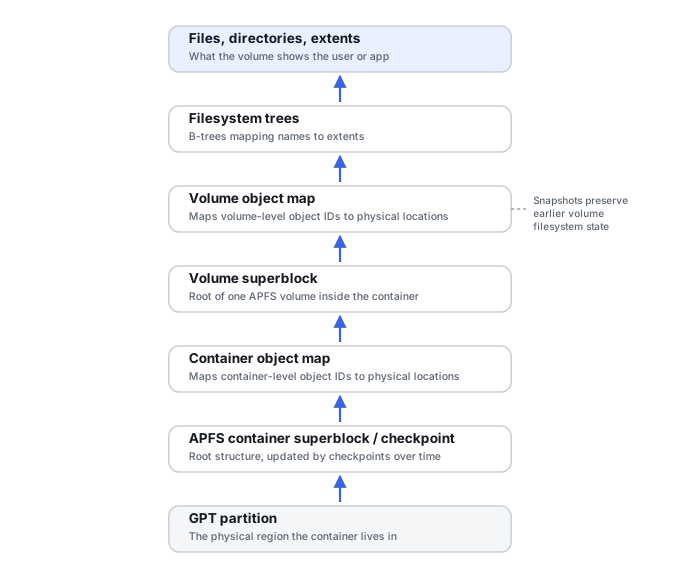
Partition, container, volumes: three different things
Apple documents APFS as a container-based architecture: a GPT partition holds one APFS container, and that container can hold multiple logical volumes that share the container's free space, along with cloning, snapshots and encryption. A simplified stack runs from the GPT partition down through the container superblock and checkpoints, the container object map and space manager, into one or more volumes, each with its own volume superblock, volume object map and filesystem B-tree. This makes an APFS failure structurally different from a single NTFS or ext4 volume failing — there are more layers, and more of them are shared between volumes.
Objects are copy-on-write, not modified in place
Apple's File System Reference states plainly that on-disk APFS objects are never modified in place: a change produces a new object at a new physical location, carrying its own object identifier (OID), transaction identifier (XID), and checksum. The old physical object can remain on disk, unreferenced by the current state, until space is reclaimed. This is one of the most consequential recovery facts in the whole cluster: APFS corruption is often a problem of selecting and reconnecting a consistent generation of copy-on-write objects, not repairing one fixed metadata location.
Transaction IDs define which objects belong together
APFS object-map records resolve a virtual object identifier at a given transaction generation (OID + XID) to a physical address, which means the same logical object can have several historical physical versions on disk at once. The transaction identifier is part of interpreting which version belongs to which filesystem state; mixing objects from incompatible transaction generations can produce a reconstruction that looks plausible but is not actually coherent. “Newest readable metadata block” is not automatically the right answer — the objects involved have to belong to the same transaction generation.
Checkpoints preserve historical container states by design
Apple documents a checkpoint descriptor and data area, structured as a ring buffer, and a defined procedure for selecting the latest valid checkpoint at mount time. A checkpoint ties together a container superblock state, ephemeral objects, checkpoint mappings and transaction state as one coherent unit. Consequently, damage to the block-zero container superblock does not necessarily mean no usable container state exists at all — older, valid checkpoints already on disk may describe a previous, still-coherent container generation. Rewriting the container header without first looking for these can destroy the evidence needed to find them.
The object map is the container's own translation layer
The object map stores mappings from logical object IDs and transaction IDs to physical block addresses, giving APFS an internal address-translation layer conceptually similar to — but structurally very different from — the flash translation layer on an SSD; the two should not be collapsed together. Recovery can fail even when a filesystem tree object exists and its physical block is intact, if the object-map lineage needed to reach it is lost or corrupted.
The volume superblock is a map to the maps
Apple documents the APFS volume superblock as pointing to the volume's key structures: its own object map, the root filesystem tree, the extent-reference tree, the snapshot metadata tree, the volume's role, and its object IDs and counters. If one current volume-superblock version is damaged, historical versions of these same structures may still exist through earlier snapshots, checkpoints or object generations — the volume superblock is a pointer, not the only copy of anything it points to.
Filesystem metadata is tree-based, and can fail at any level
APFS stores inode records, directory records, file extents, extended attributes and related data in B-trees. That means “APFS volume corrupt” is not one failure mode: the volume superblock can be visible while the root tree is not reachable; the root tree can be reachable while individual nodes are corrupt; an inode can be present while its extents are missing; a directory record can be gone while its inode survives; extent metadata can survive while the file content itself is partially overwritten. Diagnosis means identifying which tree, and which generation of that tree, is actually unreachable — not treating the whole volume as one binary state.
Snapshots are metadata branches, not backup copies
APFS snapshot metadata references a snapshot transaction ID, a volume superblock, an extent-reference tree and names/timestamps — a snapshot preserves a historical logical view by keeping those metadata and block references alive, not by duplicating every file physically. An active volume can therefore be damaged while an older snapshot remains internally coherent, and deleting a file from the active state does not necessarily free its blocks if a snapshot still references them. Apple's own support documentation confirms that Time Machine's local snapshots are built on APFS and can be automatically removed to reclaim space — which is exactly why destroying snapshots can make previously retained blocks reclaimable, for better or worse, depending on whether recovery needed them.
Space sharing, clones and quotas complicate capacity intuition
Multiple APFS volumes in one container share the container's free space, so a volume's nominal size is not a fixed, separately preallocated region. Cloned files, which Apple documents as requiring no additional storage at creation, can make two apparent files share physical extents until one diverges from the other through modification. Recovery should track container capacity, per-volume allocated blocks, quotas and reserves, shared free space, and snapshots/clones as separate quantities — summing logical file sizes will routinely overstate actual unique physical storage.
Encryption adds a dependency independent of structure
APFS encryption state lives inside object maps and volume metadata, and can span different crypto generations during key transitions. A structurally well-reconstructed encrypted APFS volume is not the same thing as decrypted file recovery — surviving blocks without the correct key context remain unreadable regardless of how completely the object map and filesystem tree have been rebuilt.
Selecting a consistent historical state
A failure can leave the newest objects partially written while earlier copy-on-write objects, and an earlier snapshot or checkpoint, remain fully intact. Recovery sometimes deliberately selects that older, complete namespace instead of a newer, broken one — a strategy closely analogous to choosing a consistent metadata generation during RAID rebuild recovery. See Storage Metadata Generations and Consistency for the general version of that principle.
Find the newest mutually consistent checkpoint, object map and volume-tree generation that can actually be traversed safely — not simply the newest object that happens to be readable.
Related: APFS Container or Volume Corruption (macOS) · Filesystem Journals and Crash Consistency · Allocation Metadata, Orphaned Files and Lost Space · Storage Metadata Generations and Consistency · Recovering Data from Snapshots and Previous Versions · File-System Recovery vs. File Carving