SSD Firmware, Translator and Controller-Level Recovery
“SSD controller failure” is really a family of different failures — silicon, firmware, translator metadata, NAND degradation, cache and encryption state can each fail on their own while leaving the others intact.
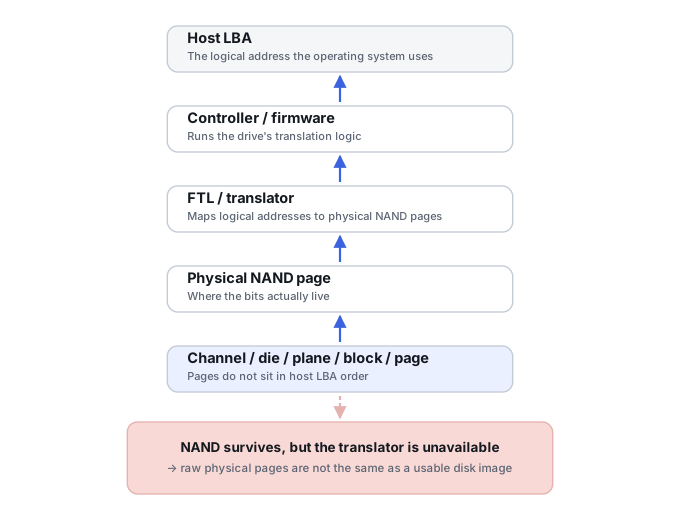
Controller failure is not one failure
The controller on a modern SSD is responsible for far more than the SATA or NVMe host interface: it manages FTL/L2P mapping, NAND scheduling, channel and interleave management, ECC/LDPC, bad-block management, garbage collection, wear leveling, TRIM/deallocate processing, caching, power-loss handling, thermal behavior, internal metadata, and often encryption or scrambling. A useful working taxonomy separates: (A) controller silicon or power failure — no enumeration, no meaningful electrical activity, shorted rails, an overheating component; (B) firmware initialization failure — a factory or safe-mode identifier, wrong reported model, hangs during identify, unstable initialization, with NAND that may be entirely healthy underneath; (C) translator/FTL metadata corruption — correct identity but invalid reads, partial logical space, large regions of zeros or errors, read-only or degraded mode; (D) NAND degradation beyond what the controller can correct; (E) a DRAM- or cache-related initialization issue; and (F) an internal security or encryption state failure, where reconstruction depends on metadata or key state that never appears as an ordinary host-visible sector. Treating “the controller died” as a single diagnosis skips the question of which of these actually happened — and they call for different recovery approaches.
The translator is part of the recoverable state, not disposable
A controller needs persistent internal metadata to rebuild its view of the NAND after every power-up. The exact structures are vendor- and controller-specific, but commonly include translation tables, block-state tables, wear information, bad-block tables, metadata journals, firmware modules, security/encryption state, and spare-area or service records. Commercial recovery platforms frequently use controller-specific service or technological modes to initialize a failed SSD just enough to reach the NAND, reconstruct the translation, disable problematic background behavior, and read logical data through controller-aware procedures — a route that is often preferable to chip-off on modern SSDs precisely because it reuses the controller's own reconstruction logic instead of reproducing it from scratch. In modern SSD recovery, the controller's metadata describing the NAND can be the more valuable object; the NAND payload alone is often not enough.
Wrong capacity and safe/factory modes are diagnostic, not just alarming
Some controllers expose an alternate identity or a reduced mode when normal initialization fails, which can actually indicate something useful: the controller is electrically alive, but NAND initialization failed, or service metadata is inaccessible, or firmware never reached its normal host-facing mode. Entering or exiting these technological modes typically requires controller-specific commands that are outside the scope of a general guide to describe safely — the point worth recording here is what the presence of such a mode tells a specialist about where in the stack the failure actually sits, not a procedure to attempt without the right tooling.
Encryption context can be as important as the NAND itself
Where a controller applies transparent internal encryption, reconstructing a usable logical image can depend on recovering the encryption context the original controller held, not only on reading the NAND cleanly. Controller-aware access that keeps the original ECC engine, translation and encryption context intact is one of the main reasons it can succeed where a generic chip-off attempt, which has to reconstruct all three from nothing, does not.
Why firmware updates are risky as a recovery-first step
Vendor firmware updates are built for functioning or officially supported devices, and applying one can update internal metadata, reset state, reinitialize data structures, change translation behavior, or trigger background maintenance — any of which can consume the very state a recovery attempt needed to read. For a device carrying irreplaceable data and showing abnormal enumeration, capture and image whatever logical state is currently available first; do not treat a firmware update as an exploratory diagnostic step.
Extract, don't repair
The objective in controller-level recovery is a stable read path to the old logical data, not a permanently repaired, reusable SSD. Even where a specialist procedure can coax a failing controller into exposing readable sectors, that access is usually treated as a one-time extraction window rather than evidence the drive itself is fixed. See Repair vs. Recovery for the general version of this distinction.
Preserve any stable logical read that already exists before attempting technological modes, firmware changes or chip-level access — a working controller, even a struggling one, is often the best NAND-reconstruction tool available for its own flash.
Related: Flash Translation Layers and NAND Mapping · Chip-Off, ISP and Monolithic Flash Recovery · SSD Recovery Fundamentals · SSD Controller Failure · Drive Shows the Wrong Capacity · Repair vs. Recovery